Product content strategy · Editorial leadership · Content operations · Commercial thinking
Overview
When I joined Intelligenti as Editor-in-Chief, its core products were Tips & Tricks for iPhone and iPad, supported by advertising revenue, alongside a newer bi-weekly magazine app called Swipe. The business was also preparing to launch TapSmart, initially conceived as a broader replacement brand that could bring the company’s content together in one place.
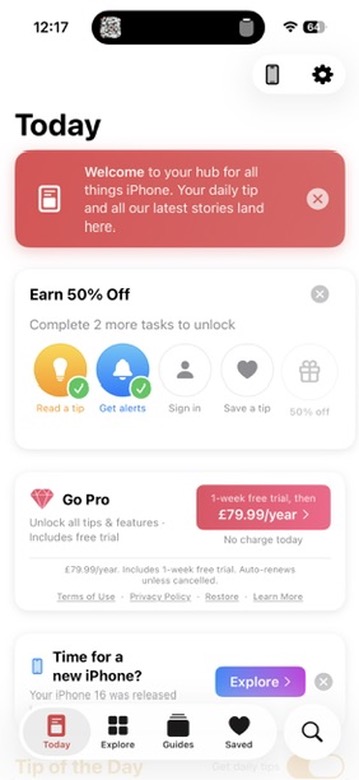
The problem was that there was no clear editorial model or sustainable route to monetisation. Tips & Tricks had an established audience, but users mainly opened it when they needed help or when a new version of iOS launched. Advertising revenue depended on people opening the app, while producing and updating content across multiple products risked becoming expensive and repetitive.
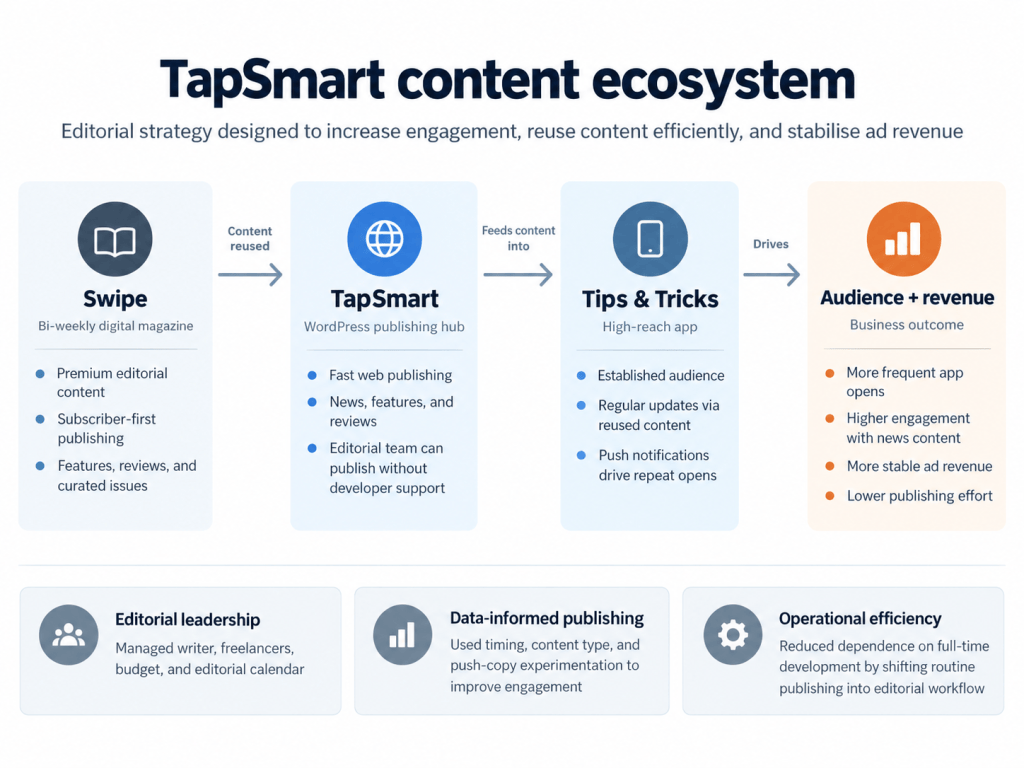
I proposed a different model: keep the established Tips & Tricks brand, use Swipe as the premium editorial engine, and launch TapSmart as a flexible WordPress-based publishing platform that could feed content into the wider product ecosystem. This created a repeatable workflow that increased the frequency of fresh content, encouraged more app opens through push notifications, reduced publishing effort, and helped stabilise advertising revenue.
Role: Editor-in-Chief
Organisation: Intelligenti / TapSmart
Products: Tips & Tricks for iPhone and iPad, Swipe, TapSmart
Team: One staff writer, around five freelancers, and external/technical support as needed
Focus: Editorial strategy, product content, publishing operations, audience engagement and commercial performance
The challenge
Tips & Tricks had strong brand recognition and remained the company’s main revenue driver, but its usage pattern was episodic. People tended to open it when they needed specific help or after an iOS update, which limited opportunities to serve advertising between major product cycles.
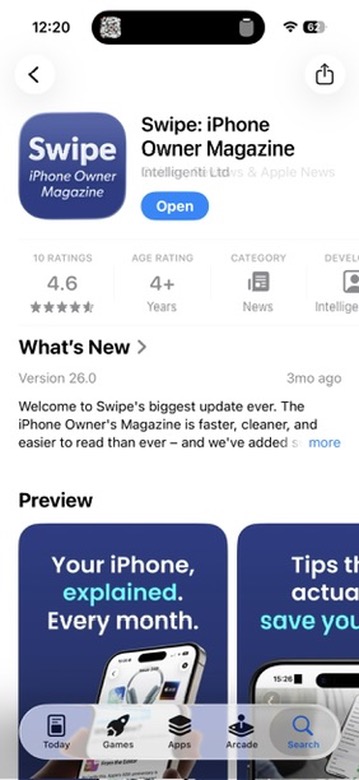
Swipe had recently launched as a subscription-based digital magazine, but its subscriber base was still modest. TapSmart was being considered as a broader replacement for the existing product family, but there was no clear editorial direction and replacing Tips & Tricks risked abandoning the strongest existing brand and audience.
The wider problem was therefore not simply to publish more content. We needed a model that could make existing editorial investment work harder, increase reasons for users to return, and reduce the amount of technical effort required to keep multiple products current.
Designing the content ecosystem
I proposed treating the products as a connected editorial ecosystem rather than separate publishing destinations.
Swipe became the premium production engine. We worked to a magazine-style editorial cycle with a defined budget, a staff writer and a network of freelancers. New content was commissioned, edited and packaged into the bi-weekly magazine first, giving subscribers early access and preserving a clear reason to pay.
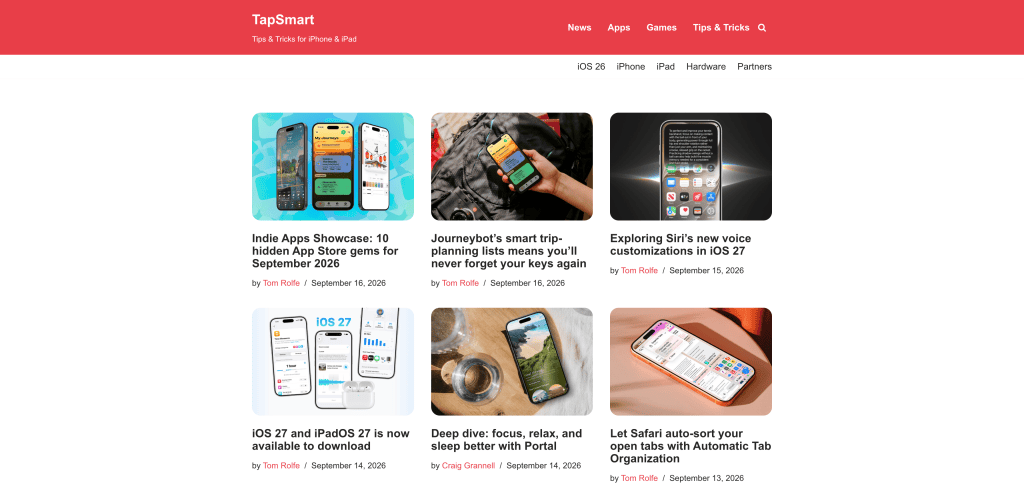
TapSmart then became the flexible web publishing layer. We launched it on WordPress so the editorial team could publish and update content without relying on full-time developers.
That same content could then be surfaced within Tips & Tricks, allowing the flagship app to receive a regular flow of news, reviews and features in addition to its core tips content.
The resulting model was effectively: Swipe → TapSmart → Tips & Tricks. One piece of editorial work could move through the ecosystem, reach different audiences at different stages, and create several opportunities for engagement and revenue.
My role
I owned the editorial and operational model end to end.
I proposed the new product relationship and publishing workflow to the company owner, who agreed the direction. I then worked with technical support to establish the initial WordPress and app integration, while keeping the ongoing publishing process in the hands of editorial rather than development.
I managed one staff writer and around five freelancers, controlled the editorial budget, commissioned and edited work, set the editorial calendar, and decided how content would be reused across products.
I also established coverage rhythms around Apple releases and iOS updates, planned the balance of news, reviews and features, and managed the push-notification schedule used to bring audiences back into the apps.
Using data to shape engagement
Push notifications became an important part of the model because fresh content only created value if users knew it was there.
I used engagement data and experimentation to develop a notification schedule. We found that too many notifications reduced effectiveness, while different content types performed better at different times: news worked well around the morning cycle, while features and game reviews could perform better closer to the weekend.
We also used audience location data to inform timing. The copy itself mattered too: I developed an approach that made the notification interesting enough to encourage an open without giving away everything the user needed in the notification itself.
That feedback loop influenced editorial planning. News in particular generated stronger app-opening behaviour, so we increased the regularity of news coverage and used notifications more deliberately around it.
Reducing publishing effort
The new model also changed how expensive it was to publish.
Much of the company’s earlier publishing work had used more traditional production methods. Swipe continued to use a designed magazine template, but the web and app content pipeline was driven through WordPress, which meant the editorial team could add and update content directly.
Content was then pulled into the app and displayed in the product design without requiring a developer to build each update. This reduced the need for permanent technical resource and allowed engineering support to be brought in only when genuinely needed.
That lower-cost publishing model also created space to experiment with additional products, including focused guides for new Apple devices and lighter entertainment-led app ideas.
Outcome
I do not have the original performance figures available, so I would avoid claiming precise numerical improvements.
However, app opens increased significantly after we introduced a more regular content and push-notification cycle. News became a particularly strong engagement driver, and that evidence encouraged us to publish it more frequently.
The model helped stabilise advertising revenue and stem the ongoing decline in a difficult market for smaller independent app publishers. Swipe subscriptions also grew steadily over time, supporting the editorial budget that produced content for the wider ecosystem.
Publishing effort was substantially reduced because editorial could manage the WordPress-driven workflow without full-time development support.
More than a decade later, the products continue to publish new content. While the products will have evolved since my time there, the longevity of the content-led model is a useful indicator that the approach proved durable.
What this demonstrates
- Product content strategy — designing the relationship between multiple products around audience, revenue and editorial value.
- Commercial thinking — connecting editorial decisions to app opens, advertising revenue, subscriptions and publishing cost.
- Content operations — creating a workflow that allowed one editorial investment to be reused efficiently across multiple channels.
- Data-informed design — using engagement behaviour to refine content mix, notification frequency, timing and copy.
- Editorial leadership — managing writers and freelancers, budgets, commissioning, calendars and quality.
- Cross-functional delivery — working with company leadership and technical support to turn the publishing model into a functioning product ecosystem.

 Andy Price